
One-to-One Coaching Case Study
From Reactive Leader to Trusted Business Driver in 4 Sessions
Three priority areas emerged:
1. Rebuild Trust and Presence
The leader was perceived as absent and less engaged, impacting credibility and collaboration.
2. Strengthen Communication Maturity
Feedback highlighted emotional reactivity and communication breakdowns under pressure.
3. Shift from Solo Operator to Collaborative Leader
The leader was seen as highly capable but increasingly disconnected from team dynamics.
These patterns were impacting trust, engagement, and leadership influence.
Coaching focused on translating insight into observable behavioural change, using a neuroscience-based approach designed to accelerate leadership shifts.
The work centred on:
- Understanding how the brain responds under pressure
- Identifying behavioural triggers affecting leadership presence
- Practising alternative responses in high-stakes situations
- Building sustainable leadership habits
- Increasing awareness of how behaviour shapes trust and collaboration
The objective was not insight alone, but rapid behavioural change.
The engagement consisted of four focused coaching sessions.
This wasn’t traditional leadership coaching.
The shift happened because the work focused on how the brain shapes behaviour, especially under pressure.
During the four sessions, he learned:
- How the brain reacts to stress
- How it interprets threat
- How thinking narrows under pressure
- How emotions directly shape communication and performance
As this awareness increased, behaviour began to shift:
- Defensiveness became awareness
- Reactivity became choice
- Pressure became manageable
Instead of focusing on communication techniques or leadership theory, we worked at the source.
We reshaped behaviour by helping the leader understand how his brain was driving his reactions.
This engagement was structured around my B.R.A.I.N. Leadership Model™, designed to accelerate behavioural change:
Biology First
Understand how the brain works in simple, practical terms.
→ Leverage that insight to influence behaviour and lead with confidence.
Rewire Patterns
Interrupt reactive loops and install new responses.
→ Replace reactivity with intention, clarity, and control.
Align Environments
Create brain-safe systems: clear, structured, and consistent.
→ Remove ambiguity, increase alignment, and build safety.
Install Habits
Embed new behaviours through structure and repetition.
→ Turn insight into action, and action into second nature.
NUMERATE Progress
Measure what matters, clearly, consistently.
→ Track leadership growth and cultural impact with KPIs.
This structure ensures that neuroscience is not theoretical and it becomes operational.
Within four sessions, noticeable changes emerged:
- Leadership style perceived as calmer and less reactive
- Increased presence and engagement with the business
- More proactive and collaborative leadership behaviours
- Improved communication and stakeholder alignment
- Rebuilding trust across the team
- Leader and team on track to significantly exceed budget expectations
Leadership feedback confirmed that the leader appeared re-engaged, more constructive, and more proactive.
The organisation also demonstrated renewed confidence by supporting the leader’s strategic vision and granting autonomy to develop a new regional hub.
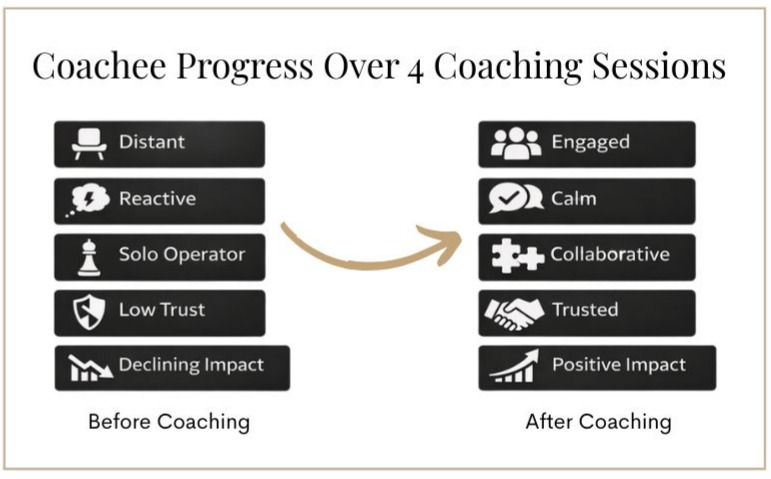
In just four sessions, the leader moved from:
Reactive → Calm
Absent → Present
Solo Operator → Collaborative Leader
Reduced Trust → Rebuilding Credibility
Declining Influence → Positive Business Impact
This engagement highlights how targeted, brain-based coaching can accelerate meaningful behavioural change and deliver measurable leadership impact in a short timeframe.
To protect his privacy, the coachee’s testimonial is not included on this page. You can read it here.
If complexity is rising.
If communication is creating friction.
If performance feels harder to stabilise...
The question is simple: Are your leaders equipped to execute strategy under pressure?
Neuroscience-based leadership empowerment strengthens how your leaders think, decide, and communicate under pressure.
